Home/Results
Results
What The Work Has Actually Produced
Two campaigns, with the numbers and the method behind them. Read the method rather than the headline figure. A number without a mechanism is decoration.
Book A Call→A word on how these are presented, before the numbers.
These are campaigns run by the people who run Ranking Out, for physical therapy practices. The practices are not named and no patient is identifiable, because a clinic's marketing performance is its own business and we are not going to trade on somebody's numbers for a testimonial we were not given.
That costs us something. A named clinic with a photograph persuades harder than an anonymous one. We would rather be believed by people who check.
Case one
Local Search And The Practice Website
What that second number means
The traffic figure is the one an agency would put on a slide. The appointments figure is the one that pays for the work.
Traffic doubling is only interesting if the extra visitors were the right people. Plenty of practices have watched sessions climb while the schedule stayed exactly as soft as it was, because the traffic came from searches with no intent behind them: information queries, people three states away, students writing papers.
Forty appointments a month is the number to hold this against. Work out what a plan of care is worth in your practice, multiply, and you have the actual figure. That is the arithmetic every marketing decision should be run through, and almost nobody does it.
How it was done
Nothing exotic. Grid position established around the practice address rather than a single city-level ranking. Profile, categories and listing consistency across the platforms patients and insurers actually check. Review volume and recency brought up and kept up. Pages built for the conditions and questions people search immediately before they call, rather than for keyword volume.
It is closer to bookkeeping than to art. Tedious, cumulative, and the reason most practices never get there is that they stop at week eight.
Case two
One Sciatica Workshop, Run On Meta
Why this shape of campaign works
Nobody on Facebook was looking for a physical therapist. They were scrolling. That is why clinics run Meta ads straight to a booking page, get nothing, and conclude the platform does not work for healthcare.
A workshop changes what is being asked for. Instead of asking a stranger in pain to commit to a course of care, you ask them to come and listen for an hour. That is a far smaller decision, and it puts the person in a room with a clinician before any money is discussed. Roughly half the room booked.
The number underneath the numbers
Twenty-two appointments from forty-three attendees is a conversion rate no cold ad campaign reaches, because by then it is not a cold audience. They turned up, they listened, and they met somebody who understood their problem.
And twenty-two thousand dollars from a single afternoon is the argument for running these on a calendar rather than once, when the schedule gets frightening. Here is how that campaign is built, step by step. The practices that treat workshops as a system rather than a rescue are the ones that stop having quiet Januaries.
Case three
A Multi-Location Medical Group, Outside Physical Therapy
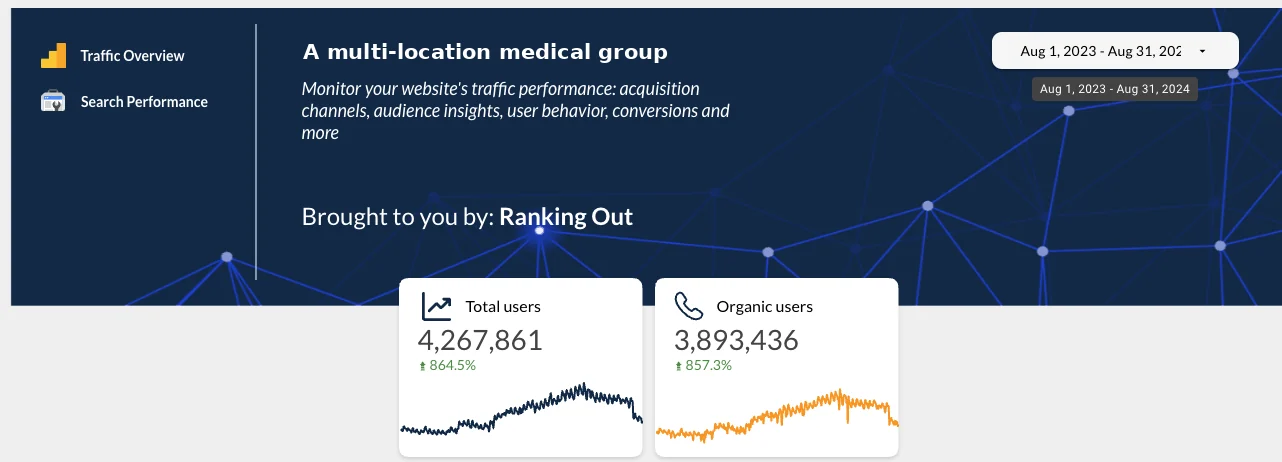
Why a case from outside the niche is here
The local search mechanism does not change with the specialty. Profile and listing work, location pages, review volume and the technical base behave the same way for a vascular group as for a physical therapy clinic. What changes is the vocabulary, which is the part we would have to learn if we took a specialty we did not already know.
It is here because the shape of the curve is the point: close to flat for the first stretch, then compounding, and still compounding a year later. That is what the search work does, and it is the reason the engagement is twelve months rather than three.
What These Numbers Do Not Tell You
We would rather say this ourselves than have you wonder.
- These are two campaigns, not an average. They are real and they are documented, and they are not a promise of what happens in your practice.
- Market, list and offer decide most of it. A dense metro with six competitors on the same street behaves differently from a town with one. A practice with three thousand past patients behaves differently from one with four hundred.
- The front desk decides the rest. Every one of those appointments had to be answered, confirmed and attended. Demand delivered into a practice that cannot receive it turns into nothing, expensively.
- We will not quote you these figures as a forecast. On the call you get a range for your own situation, and it will be narrower and lower than what somebody else has promised you. On the reactivation campaign there is a number we put money behind.
Want The Same Arithmetic Run On Your Practice?
Bring three numbers: what a patient is worth across a plan of care, roughly what share of enquiries become paying patients, and how many contactable past patients are sitting in your system. The full inventory of what is already sitting in your practice takes an afternoon and costs nothing. We will tell you what is realistic and which piece we would start with.
Book A Call→Or see what it costs before you spend the time, and the person who ran these campaigns.